Java
Java is a programming language and a platform. Java is a high level, robust, object-oriented and secure programming language.
Platform
Any hardware or software environment in which a program runs, is known as a platform. Since Java has a runtime environment (JRE) and API, it is called a platform.
Object-oriented programming
(OOPs) is a methodology that simplifies software development and maintenance by providing some rules.
JVM (Java Virtual Machine) Architecture
JVM (Java Virtual Machine) is an abstract machine. It is a
specification that provides runtime environment in which java bytecode
can be executed.
The JVM performs following operation:
- Loads code
- Verifies code
- Executes code
- Provides runtime environment
Classloader
Classloader is a subsystem of JVM which is used to load class files. Whenever we run the java program, it is loaded first by the classloader.
Just-In-Time(JIT) compiler
It is used to improve the
performance. JIT compiles parts of the byte code that have similar
functionality at the same time, and hence reduces the amount of time
needed for compilation. Here, the term “compiler” refers to a translator
from the instruction set of a Java virtual machine (JVM) to the
instruction set of a specific CPU.
Java Native Interface
Java Native Interface (JNI) is a framework which provides an
interface to communicate with another application written in another
language like C, C++, Assembly etc. Java uses JNI framework to send
output to the Console or interact with OS libraries.
Types of Variables
There are three types of variables in Java:
- local variable
- instance variable
- static variable
[Image: Untitled 15.png]
i
Object
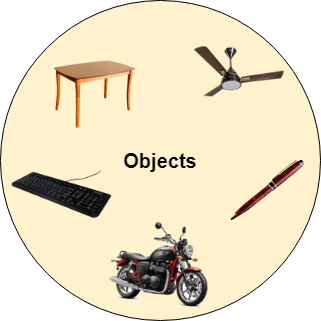
Any entity that has state and behavior is known as an object. For
example, a chair, pen, table, keyboard, bike, etc. It can be physical or
logical.
An Object can be defined as an instance of a class. An object
contains an address and takes up some space in memory. Objects can
communicate without knowing the details of each other’s data or code.
The only necessary thing is the type of message accepted and the type of
response returned by the objects.
Example: A dog is an object because it has states
like color, name, breed, etc. as well as behaviors like wagging the
tail, barking, eating, etc.
Class
Collection of objects is called class. It is a logical entity.
A class can also be defined as a blueprint from which you can create an individual object. Class doesn’t consume any space.
Inheritance
When one object acquires all the properties and behaviors of a parent object, it is known as inheritance. It provides code reusability. It is used to achieve runtime polymorphism.
Polymorphism
If one task is performed in different ways, it is known as
polymorphism. For example: to convince the customer differently, to draw
something, for example, shape, triangle, rectangle, etc.
In Java, we use method overloading and method overriding to achieve polymorphism.
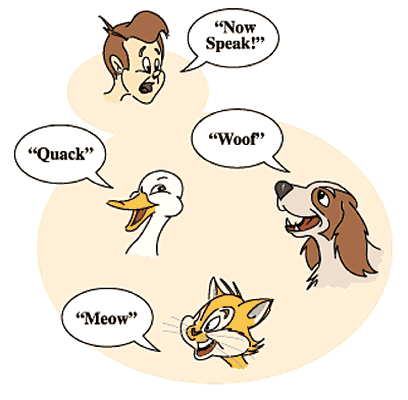
Another example can be to speak something; for example, a cat speaks meow, dog barks woof, etc.
Abstraction
Hiding internal details and showing functionality is known as abstraction. For example phone call, we don’t know the internal processing.
In Java, we use abstract class and interface to achieve abstraction.

Encapsulation
Binding (or wrapping) code and data together into a single unit are known as encapsulation. For example, a capsule, it is wrapped with different medicines.
A java class is the example of encapsulation. Java bean is the fully
encapsulated class because all the data members are private here.
Coupling
Coupling refers to the knowledge or information or dependency of
another class. It arises when classes are aware of each other. If a
class has the details information of another class, there is strong
coupling. In Java, we use private, protected, and public modifiers to
display the visibility level of a class, method, and field. You can use
interfaces for the weaker coupling because there is no concrete
implementation.
Cohesion
Cohesion refers to the level of a component which performs a single
well-defined task. A single well-defined task is done by a highly
cohesive method. The weakly cohesive method will split the task into
separate parts. The java.io package is a highly cohesive package because
it has I/O related classes and interface. However, the java.util
package is a weakly cohesive package because it has unrelated classes
and interfaces.
Association
Association represents the relationship between the objects. Here,
one object can be associated with one object or many objects. There can
be four types of association between the objects:
- One to One
- One to Many
- Many to One, and
- Many to Many
Let’s understand the relationship with real-time examples. For
example, One country can have one prime minister (one to one), and a
prime minister can have many ministers (one to many). Also, many MP’s
can have one prime minister (many to one), and many ministers can have
many departments (many to many).
Association can be undirectional or bidirectional.
Aggregation
Aggregation is a way to achieve Association. Aggregation represents
the relationship where one object contains other objects as a part of
its state. It represents the weak relationship between objects. It is
also termed as a
has-a relationship in Java. Like, inheritance represents the is-a relationship. It is another way to reuse objects.
Composition
The composition is also a way to achieve Association. The composition
represents the relationship where one object contains other objects as a
part of its state. There is a strong relationship between the
containing object and the dependent object. It is the state where
containing objects do not have an independent existence. If you delete
the parent object, all the child objects will be deleted automatically.
Advantage of OOPs over Procedure-oriented programming language
-
OOPs makes development and maintenance easier, whereas, in a
procedure-oriented programming language, it is not easy to manage if
code grows as project size increases. -
OOPs provides data hiding, whereas, in a procedure-oriented programming language, global data can be accessed from anywhere.

Figure: Data Representation in Procedure-Oriented Programming
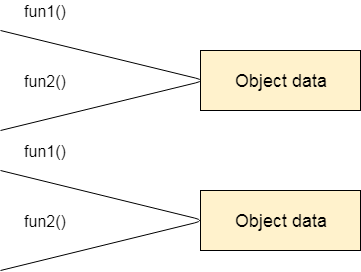
Figure: Data Representation in Object-Oriented Programming
- OOPs provides the ability to simulate real-world event much more
effectively. We can provide the solution of real word problem if we are
using the Object-Oriented Programming language.
Constructors in Java
In Java, a constructor is a block of codes similar to the method. It is called when an instance of the class is created. At the time of calling constructor, memory for the object is allocated in the memory.
Multithreading
- in Java is a process of executing multiple threads simultaneously.
Thread
A thread is a lightweight subprocess, the smallest unit of processing. It is a separate path of execution.
Exception Handling in Java
Advantage of Exception Handling
3.
Hierarchy of Exception classes
4.
Types of Exception
5.
Exception Example
6.
Scenarios where an exception may occur
The Exception Handling in Java is one of the powerful mechanism to handle the runtime errors so that the normal flow of the application can be maintained.